


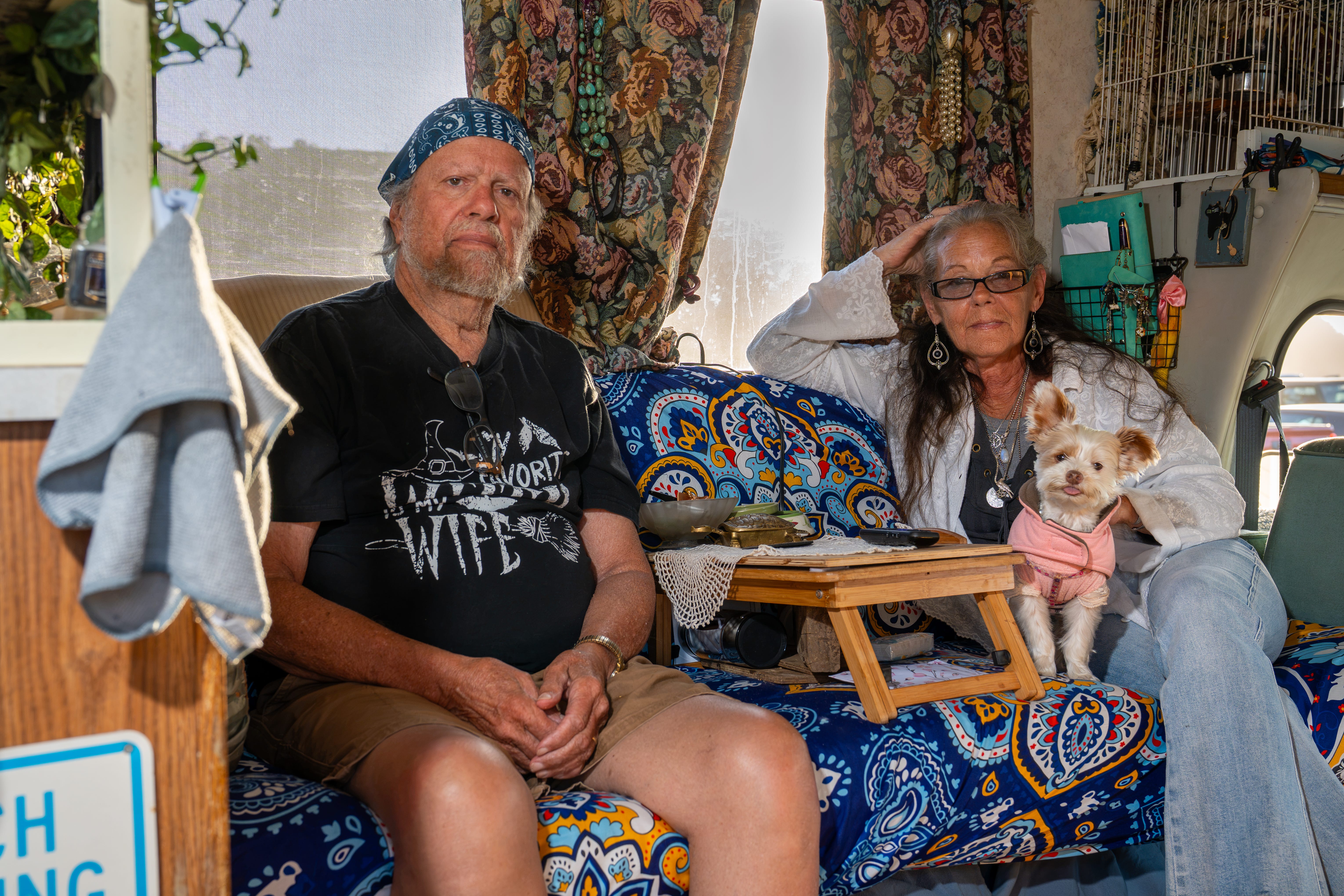
“Does my house look like trailer trash?”
As she unlocked the door to her motorhome, Dana Fink extinguished her freshly lit cigarette before entering her tightly packed living quarters.
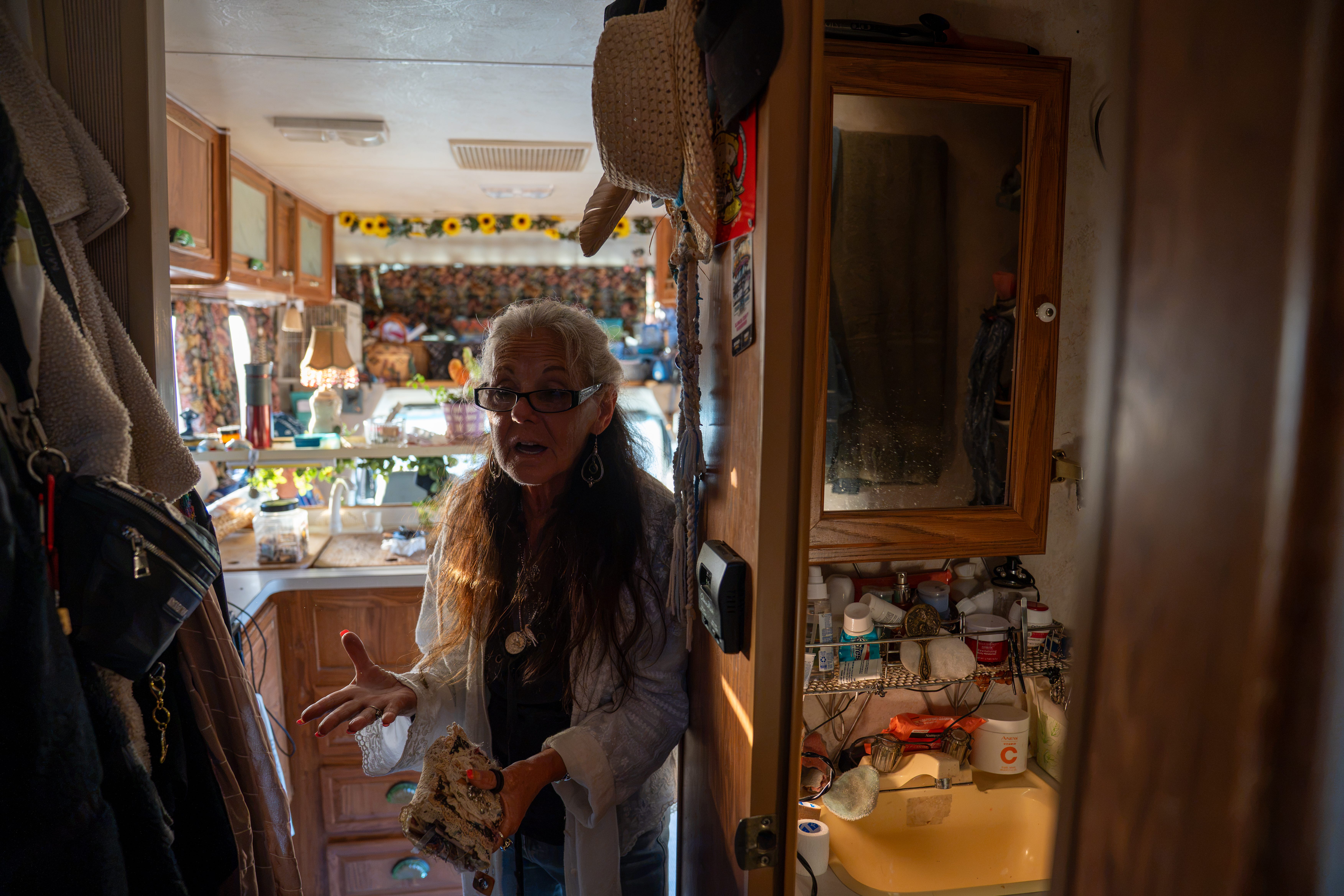
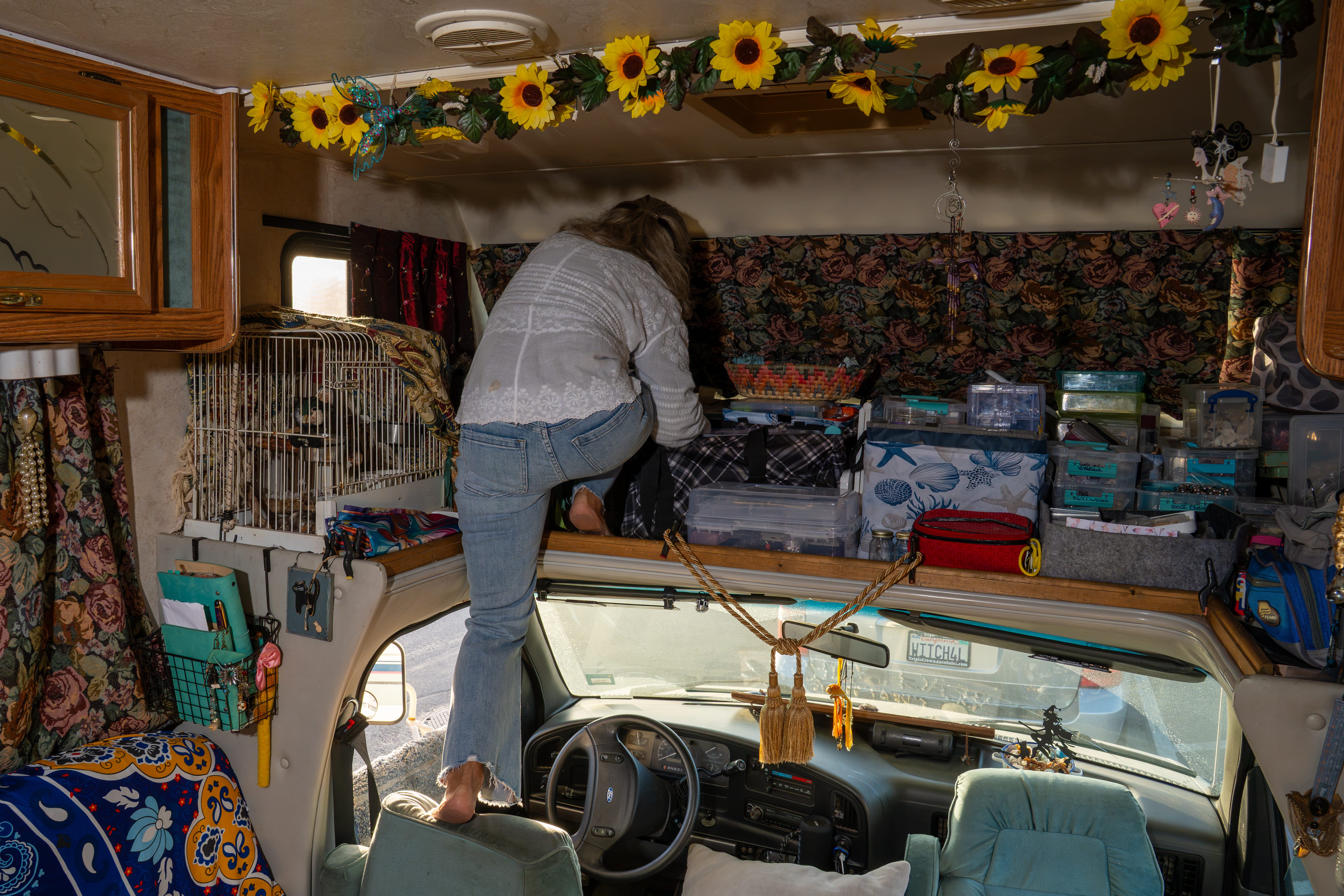
“It’s more boho than most motorhomes, but that’s because that’s who I am,” she said. “We redid it this way to fit us.”
Inside, there’s clutter but not a mess.
Stray seashells lay on the ground, with stuffed bears occupying the couch. Old family photos are plastered all over the limited wall space, along with signs referencing witches. A TV takes up a large part of the living area, and it works — her husband Ken’s favorite place to watch White House briefings and Fox News.
A bird sings from the right-hand corner of their motorhome while a white spotted Yorkie named Bella runs around.
Dana and Ken bought the motorhome for $7,000 about a decade ago and named it “Diamond,” a tribute to the home her grandfather built for her grandmother in San Francisco’s Diamond Heights.
Living in their motorhome costs the couple $1,500 a month between gas, propane and essentials. They disagree with being described as unhoused, and would rather be called “relocated.”
“I’m here because my husband is f—ing sick,” Dana said. “Would I choose to be here over the summer? Absolutely. I’m healthier. I’m happier. I love the freaking ocean. But I’m here for a reason.”
For the Finks, the motorhome is more than a vehicle. For now, it’s their home, their refuge and their way of staying close to Stanford Medical Center.
Since September 2024, Ken, 74, has been battling an aggressive form of stage-four bladder cancer that has since spread throughout the rest of his body. He’s undergone chemotherapy at Stanford Medical Center for the last year, but the treatment hasn’t been working.
For Dana, the threat of losing her husband looms large daily.
“I’m scared s—less,” Dana said. “That’s a slight f—ing understatement. I’m really good at compartmentalism, especially when he’s listening. But I’m scared. After so many years of being with somebody, you don’t have a singular identity anymore.”
Instead of driving a 280-mile round trip from their home in Calaveras County to Stanford for Ken’s treatment, they essentially cut the middleman, packed their motorhome and settled at Linda Mar Beach.
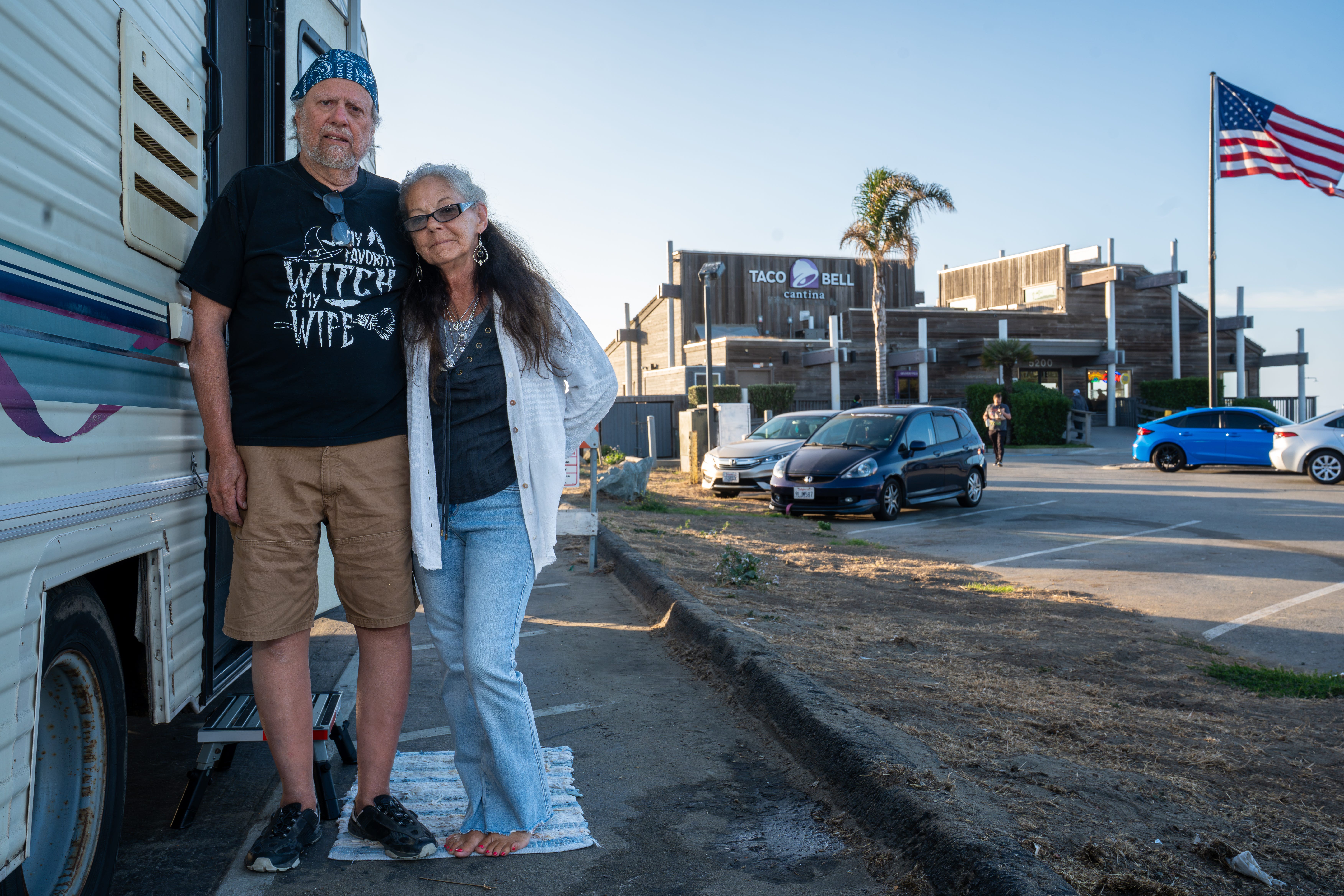
But Dana — a self-proclaimed “beach gypsy” — had other reasons to choose the beach.
“The ocean’s always been my thing,” Dana said. “It keeps me grounded, and it’s probably the only thing that’s kept me from completely losing my mind.”
There’s no question that Linda Mar Beach in Pacifica is an attraction on bright, sunshiny days during the Peninsula’s summer months. The soothing sound of waves crashing almost creates a zen-like atmosphere — it’s laid-back, yet eventful.
It’s a destination with intense appeal for different walks of life — an open-book secret for surf enthusiasts and a reliable time for out-of-town tourists to cross off a TikTok bucket list item, the world-famous beachside Taco Bell Cantina.
But beneath the crisp sand and tequila-laced Baja Blasts lies a double-edged sword — the beach has also become the center of a growing dispute over overnight parking and the people who live in vehicles.
At one point, several RVs and motorhomes set up shop for overnight stays in the beach parking lot. Pacifica residents described the scene on social media as encampments and viewed the developments as another concern hanging over the cleanliness image of their city.
The outrage turned to action. A community petition launched on June 29 and currently has nearly 1,400 signatures supporting the removal of motorhomes and RVs taking up space — hard-to-find parking, too – in the beach lot.
In late July, the California Coastal Commission approved the City of Pacifica’s request for an Emergency Coastal Development Permit, allowing the city to close the beach overnight.
“The City applied for a Coastal Commission Emergency Permit for the overnight closure of the parking lots due to the escalating public safety, vandalism and dumping consequences from allowing vehicles to remain continuously and function as long-term residences,” the city wrote in an unsigned statement. “The growing concentration of vehicles in the lots overnight has also degraded public access and reduced the public’s ability to access and enjoy the area.”
At one point, five or six motorhomes and campers were stationed near Linda Mar Beach. After the closure, they adhered to the ruling and vacated.
Everyone except for the Finks.
In Dana’s mind, the beach closure is the ultimate travesty. She didn’t think of her and her husband as a nuisance to the community — the two of them spend time picking up trash left on the beach and enjoy the constant back-and-forth with locals.
Why us, she thought.
Dana Fink has always had a rebellious side.
At 15-years-old, she abandoned her life in San Mateo to become involved with Carnaval San Francisco, the public celebration that produces street parties, parades, music and dancing.
It was there, in the 1980s, that she met Ken Fink, an employee for Butler Amusements and a jack-of-all-trades. He was George “Bud” Butler’s right-hand man for decades, and he built his reputation as a handyman extraordinaire who could solve any issue while setting up for a state or local fair in California.
Dana was enamored by him, but there was an issue
He was a married man with two children, a tough hurdle to crack.
But when Ken’s first marriage dissolved, a patient Dana — she says she waited a decade for her prize — seized the opportunity.
“I went to his house to take a shower and never left,” she laughed.
Dana, short and outspoken with a no-nonsense attitude, and Ken, a soft-spoken man with long, biker-club-style hair, seem like unlikely counterparts. But the pair settled in Calaveras County and have been married for more than 30 years.
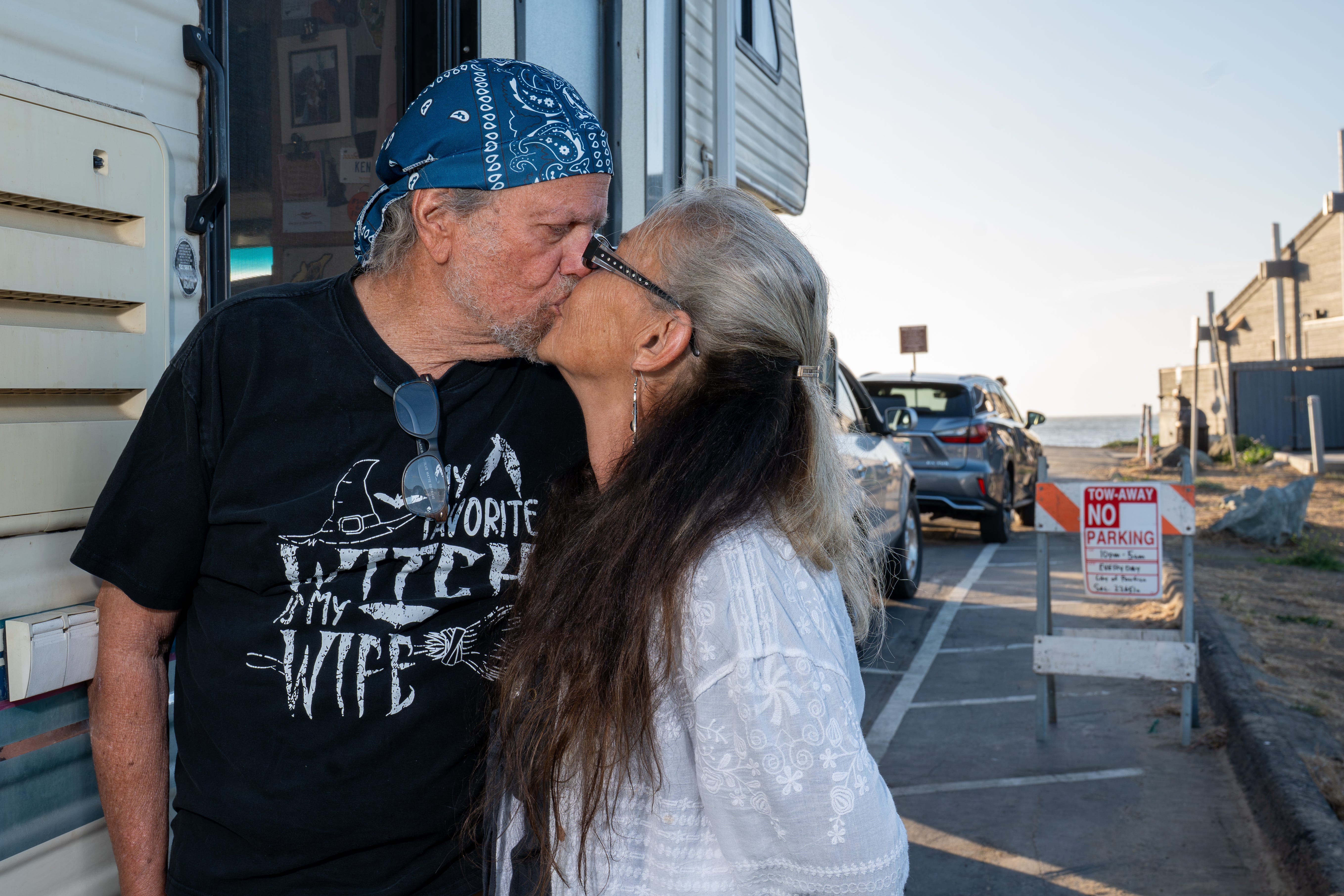
Now, the duo is battling the most challenging moment of their lives.
The beach has offered Dana something she says she can’t find at home.
“This is my therapy,” she said.
But life at Linda Mar hasn’t been without problems, and it hasn’t been all sunshine and rainbows.
Dana and Ken have faced harassment from several locals who object to their setting up shop in Linda Mar. In one incident, a group of high school-aged children doused their motorhome in ketchup.
“I come out, and there’s ketchup on the side of my motorhome,” Ken said. “What are we in, the f—ing third grade? I mean, Jesus Christ.”
On another occasion, someone loosened the vehicle’s septic tank. In both cases, they declined to press charges, reasoning that there was no need to ruin a kid’s life over it.
“I’m not going to get bullied out of here,” Dana said. “I’m just not. We’re not parasites. Everybody’s story is different.”
Emilio Moreno has experienced similar harassment in his motorhome.
A retired automotive engineer from Detroit, Moreno drove his rig to Northern California last April to begin a new life—one centered around surfing. He’s in the water every day, even with a shattered collarbone he has yet to have repaired.
Like the Finks, Moreno stayed in the Linda Mar lot before it was closed at night, and he, too, encountered problems with preteens tagging his motorhome with graffiti.
“It’s exactly like Karate Kid, the first movie,” Moreno said. “It’s exactly like it. I’m like I’m the new kid in town. Everybody wants a piece of me or something.”
Moreno caught the perpetrators on video, but nothing has come of the exchange. He recently enrolled in Pacifica’s Safe Parking Program — a city initiative Dana is hesitant to join herself because of a lack of proximity to the beach.
Now that the beach is closed from 10 p.m. to 5 a.m., the Fink’s have to relocate each evening and return before sunrise. In some cases, their only option is to park in residential areas.
Dana says Mayor Christine Boles suggested Linda Mar Boulevard — near the fire house — as an option to stay for the night, but Pac Bay Christian School put up signs to keep them away.
“People they supposedly don’t want in their parking lot are now scattered throughout their neighborhood, sleeping in front of their house,” Ken said. “Why do you want to take what you don’t want at the beach and put them on your front porch?”
The new arrangement has left the Finks frustrated, and they’re hoping Pacifica City Council and the Coastal Commission take necessary steps to lift the restriction.
“Open up the beach,” Dana said. “I mean, they got the people that they wanted to leave left, and there were people here taking advantage of it.”
For now, Dana is preparing for her next step: a head-on battle to support Ken through his cancer fight.
He’s slated to begin a new round of chemotherapy treatment at Stanford on Oct. 1. If that’s unhelpful, a clinical trial would follow.
But Ken’s cancer continues to spread, and quickly.
In a perfect world, the beach is where they’d like to call home.
“It’s got healing properties: the salt air, the sound,” Dana said. “This is my therapy, and they took it away.”